RECALLANT FIELDNOTES / ISSUE 03
Named. Cited. Chosen?
Read AI visibility without mistaking attention for a recommendation.
Published 19 November 2026 · Editorial guide · Read with the publication-date context
Separate names, citations, recommendations and enquiries. Record where and when an answer appeared, then improve the facts a buyer needs.
Download the 12-page edition (PDF)This HTML edition is the accessible reading alternative to the visual PDF.
FIELDNOTE 01
The short version
A mention tells you less than it appears to.
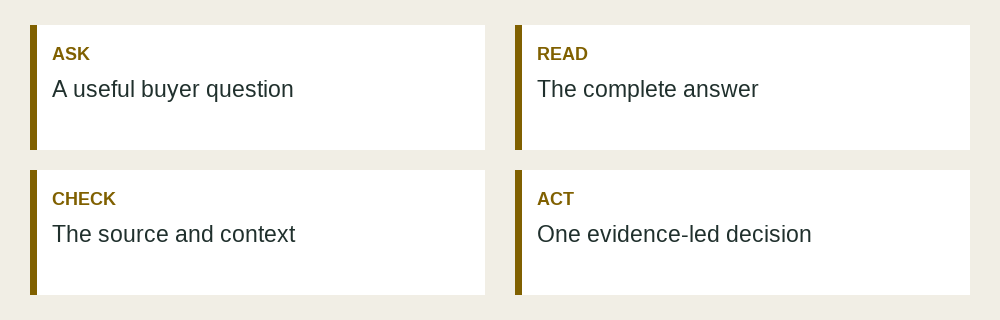
An AI answer names a furniture workshop. Is that good news? Perhaps. It might be a recommendation, a comparison, a warning or a passing reference. The useful evidence is the sentence around the name and the question that produced it.
This issue gives a small business a proportionate way to inspect that evidence. Use it after checking the accuracy of your own website and listings. Start with the questions customers actually ask and the business facts you can maintain.
A periodic check may be enough when there is little evidence that AI discovery matters to your customers. Increase attention only when the information could change a business decision. Treat a dramatic screenshot as one observation and ask whether it changes a practical decision.
FIELDNOTE 02
Five different observations
Keep each label attached to its evidence.
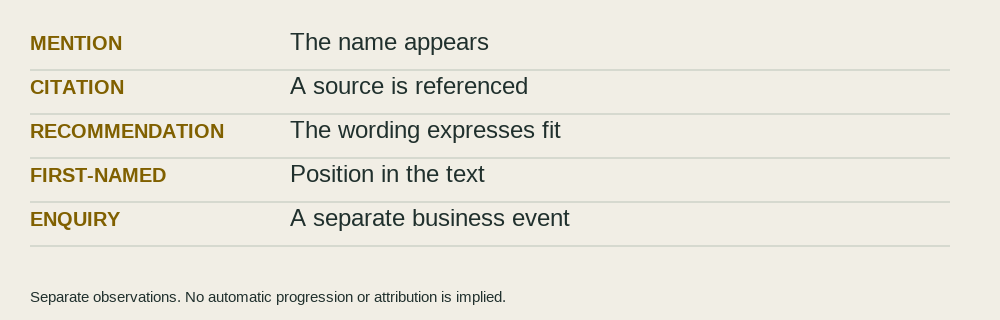
A mention means the brand is named. A citation means a source is linked or otherwise identified. A recommendation requires wording that expresses a preference or suitable choice. First-named order records position in the text; it does not establish endorsement. An enquiry is a separate event in the business’s own records.
These observations can coexist, but none guarantees the next. An answer can cite your website while recommending another supplier. It can recommend your service without linking your domain. A prospective buyer can read an answer and contact you later through an untracked route.
Keep a copy of the complete answer and its sources. If a dashboard supplies only a score, ask how that score is calculated and inspect examples. A number without a definition is mostly typography.
FIELDNOTE 03
An answer under the magnifier
Invented example, not a captured AI result.
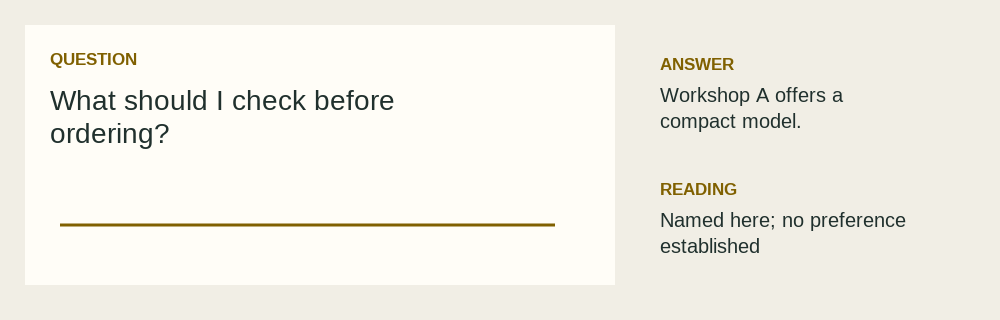
Question: “What should I check before ordering a desk for a small room?” Invented answer: “Measure the usable space and access route. Workshop A offers a compact model. Compare its dimensions and assembly terms with other suppliers before ordering.”
Workshop A is named. The wording does not establish that it is the best option. If a link points to Workshop A’s specification page, that would be an owned-site citation, but the answer still asks the reader to compare.
Now change the sentence to “For the stated width limit, Workshop A is the best fit among these options.” That expresses a preference within stated conditions. In a real AI answer, that wording would express a recommendation to verify, not proof of product quality or a customer purchase. The words around the brand do the work.
FIELDNOTE 04
Choose questions before collecting answers
Avoid building a test around the result you want.
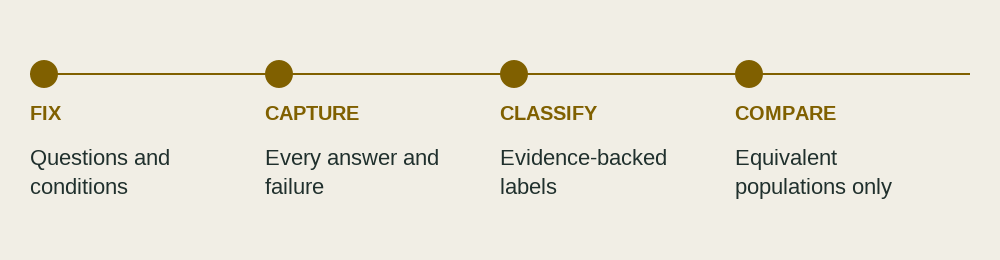
Write a small panel of genuine buyer questions: suitability, alternatives, comparisons and practical requirements. Separate questions that name the brand from those that do not. A prompt containing your own name naturally changes what an answer might discuss.
Record the language, market, surface and settings. Consumer chat and API outputs should not be treated as interchangeable observations. Note whether browsing was enabled and whether the session carried earlier context.
Repeat questions consistently if repeatability matters, while retaining every attempt and failure. Do not keep asking until a pleasing answer appears and then call that the baseline. A practical panel samples specific questions. Its coverage of customer demand and possible answers remains limited.
FIELDNOTE 05
The denominator deserves a label
A failed capture is not a negative answer.
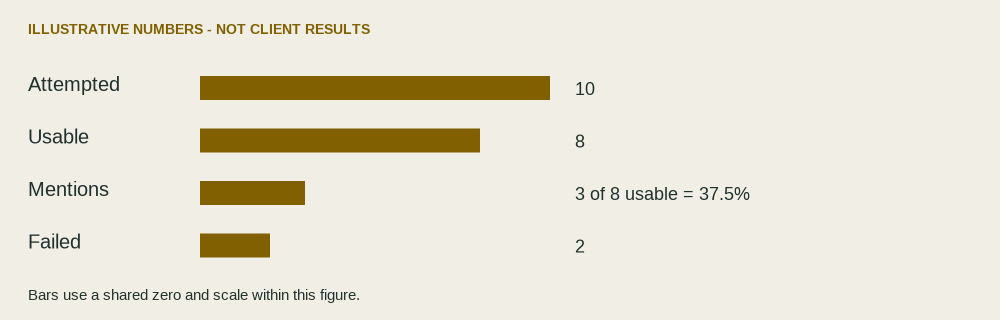
Invented collection: 10 attempted captures; 2 fail; 8 return usable answers; 3 of those mention the workshop. The observed mention fraction is 3 of 8 usable answers, or 37.5%. Report the 2 failures alongside it. Do not quietly call the result 3 of 10 unless you explicitly define a different attempted-capture metric.
Small samples are volatile. One extra mention would move this example to 4 of 8. That is a large percentage change with very little underlying evidence. Repeated answers from one setup may also be dependent, so simple statistical assumptions need care.
Use counts and descriptions before ranking brands by small differences. The purpose is to find inspectable patterns and questions worth investigating, not to manufacture a precise-looking league table.
FIELDNOTE 06
Reading the October study’s scope
A worked example of checking the population behind a chart.
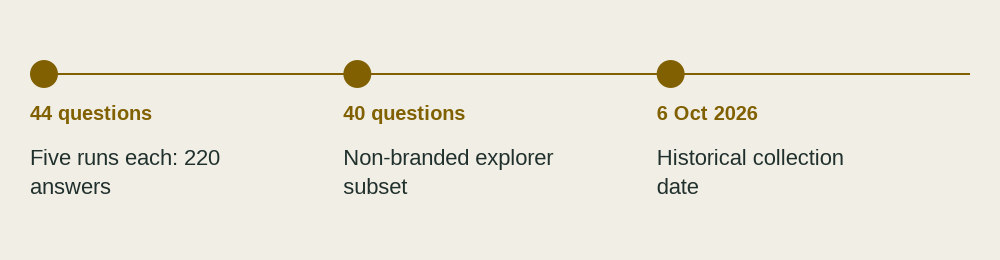
Recallant’s published helpdesk study records 44 questions repeated five times, producing 220 answers collected on 6 October 2026. The public explorer uses a 40-question non-branded subset. Those populations must not be mixed.
Automated first-named order in that record is a positional measure, not a verified recommendation. The study also reports a separate ten-answer manual ChatGPT check; its different collection method makes it a separate observation. For a concrete scope check, 44 minus 40 leaves four questions outside that explorer subset. A chart of the subset cannot answer a question about all 44 without examining the exclusions.
This magazine does not rerun that research or claim the results describe today’s answers. It uses the study as an example of why dates, question sets and definitions belong beside a chart. It is not evidence of a client outcome or of an improvement caused by Recallant.
FIELDNOTE 07
Google reporting, checked November 2026
A dedicated view with a defined measurement scope.
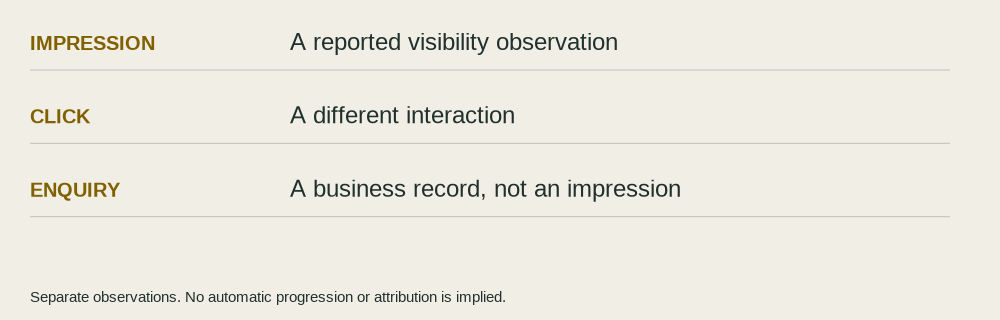
Google now documents a dedicated Generative AI performance report for Search, covering impressions in AI Overviews and AI Mode. Its help page states worldwide rollout as of 31 August 2026. A missing report can reflect insufficient impressions.
The report’s documented metric is impressions, not a separate AI click or revenue measure. Its data is included in the broader Web performance reporting: do not add it to the overall total as extra traffic. Check date, country, device and page scope when comparing views.
This section was checked on 19 November 2026 against the current report reference, including its “Not seeing the report?” and “More about the data” sections. Recheck that reference before building a recurring report around a tutorial or screenshot.
FIELDNOTE 08
Improve the page a buyer lands on
Answer the practical questions you can control.
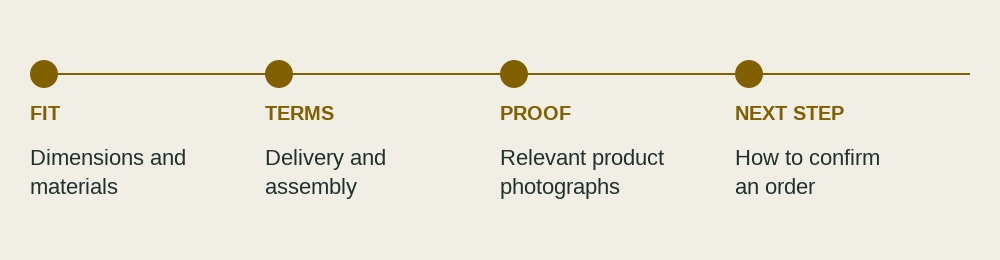
For our invented workshop, the useful page explains dimensions, materials, delivery coverage, assembly and how to confirm a custom order. It shows the actual item and links the applicable terms. These details help a buyer assess fit even when no AI system chooses to cite the page.
Google’s current guidance continues to connect AI-search visibility with SEO fundamentals, useful original content and relevant images or video. It cautions against mass-producing query variations primarily to manipulate results.
A small business can therefore start with one important page and its genuine information gaps. Collect the facts from the people doing the work. Add photographs that show the feature being discussed, rather than a decorative image that merely shares the mood. No page format guarantees inclusion.
FIELDNOTE 09
The visibility record
A practical worksheet for a bounded check.
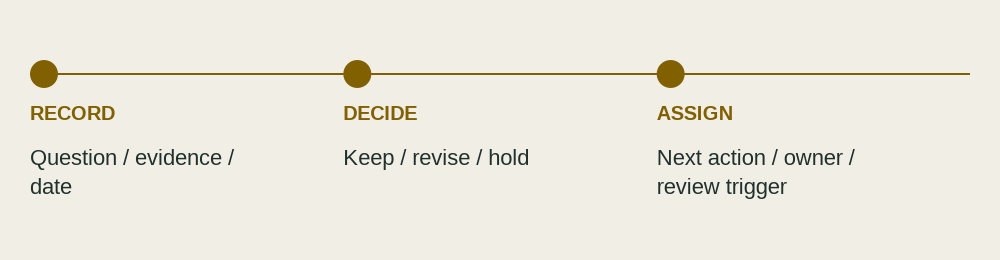
Record the buyer question, reason for including it, exact wording, language, market, product surface, collection date and relevant settings. Save the complete answer and cited URLs where permitted. Mark failed or unavailable captures explicitly.
Classify mention, owned-domain citation, recommendation wording and first-named position separately. Add the sentence supporting each classification and note ambiguous cases. Let another reader challenge the labels before aggregating them.
Finish with the business implication. Does the answer misstate an important specification? Is the correct source absent from your own page? Or is the observation interesting but not actionable? Keep this decision alongside the evidence so another round of collection has a purpose.
| Question and surface | Capture and date | Label and passage | Next action |
|---|---|---|---|
| Record here | Record here | Record here | Record here |
| Record here | Record here | Record here | Record here |
FIELDNOTE 10
A sensible next move
Fix a fact before buying a bigger number.
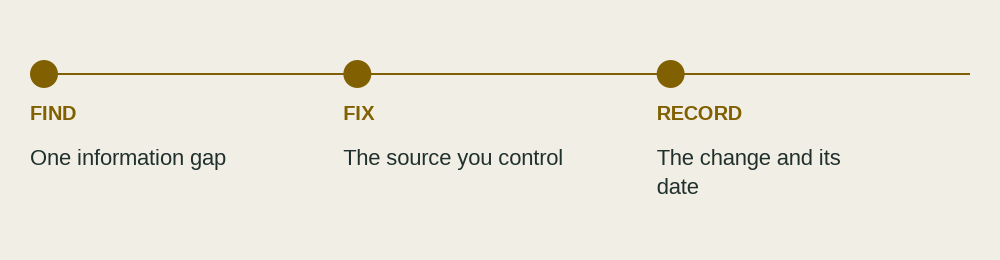
Choose one recurring information gap and correct the source you control. For the workshop, that might be a delivery page that never says which areas it serves. Record the change date and check that the page works for a person on a phone.
If you later repeat an answer check, retain the original panel and note what else changed. Different answers after a page edit do not prove the edit caused them. Product updates, source changes and ordinary variation remain plausible explanations.
For the next question—whether visibility leads to useful conversations—turn to The Enquiry Ledger. It uses the business’s own records rather than repeating the answer sample. Keep those two investigations distinct.
Sources and editorial method
These reports combine original practical guidance with the specific primary references linked beside factual claims. They are not fresh tool benchmarks, customer case studies or guarantees. Examples are invented; historical research stays dated. AI-assisted drafting and critique supported production. References reflect the publication-date review; this is not a live or continuously checked report.
- Google: optimising for generative AI search - checked 19 November 2026.
- Google: Generative AI performance report - checked 19 November 2026.
- Recallant: dated helpdesk study and method - checked 19 November 2026.
Correction or question? hello@recallant.com
Explore all four issues