RECALLANT FIELDNOTES / ISSUE 04
The Enquiry Ledger
Find out which attention becomes a useful conversation.
Published 19 November 2026 · Editorial guide · Read with the publication-date context
Define an enquiry, keep unknown sources visible and follow the conversation through to its actual outcome.
Download the 12-page edition (PDF)This HTML edition is the accessible reading alternative to the visual PDF.
FIELDNOTE 01
Begin where the customer arrives
Two-minute summary: follow the enquiry through to its outcome.
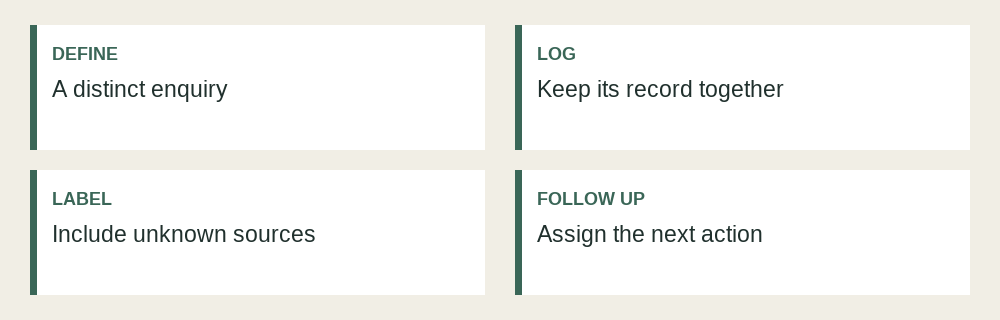
A workshop receives a form submission, a phone call and a social message. Those are three contacts, but they may concern one project. Counting them as three leads makes the chart look busy and the business harder to understand.
Define the unit you want to track: a distinct enquiry about a possible purchase. Keep the contact history together, with a simple internal reference. Then decide what makes an enquiry relevant to the service you can actually deliver.
This issue uses invented workshop records to explain a modest enquiry log. It does not claim to reconstruct every customer journey or assign revenue to AI search. The useful outcome is a clearer picture of what arrived, what happened next and where the business is losing track.
FIELDNOTE 02
Write the qualification rule
A useful conversation needs a shared definition.
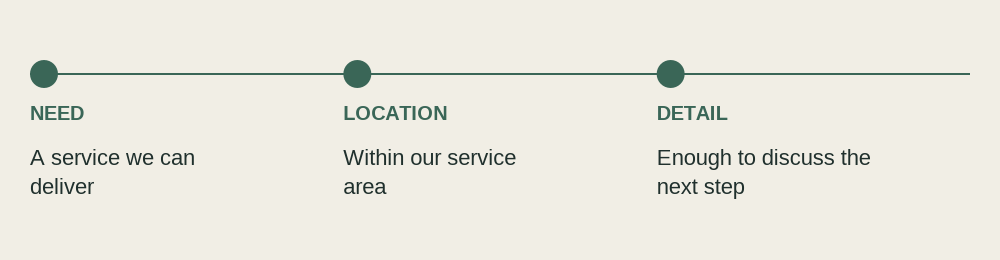
For the invented workshop, a qualified enquiry includes a product need the workshop serves, a location it can deliver to and enough detail to discuss the next step. A spam message, duplicate or unrelated supplier pitch does not qualify.
These are example criteria, not universal rules. A new business may need to learn from incomplete enquiries rather than dismiss them. Use statuses such as needs clarification, relevant, outside scope and closed, with a short reason.
Do not make the website form collect every possible detail merely to improve a spreadsheet. Ask what is necessary to respond, and gather further context in the conversation. Keep personal information limited to a legitimate business need, with access and retention appropriate to your obligations.
FIELDNOTE 03
Let unknown stay unknown
Missing attribution is information about your measurement.
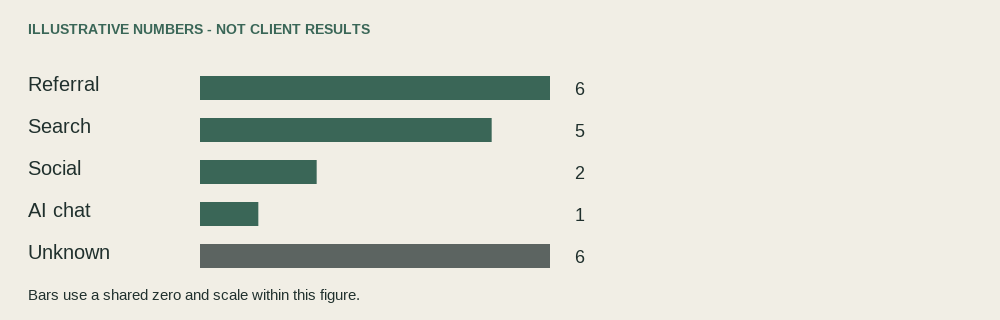
Illustrative month: 20 distinct enquiries. Six people report a referral, five report search, two report social media, one reports an AI chat tool and six give no usable source. These categories are self-reported first discovery in this example, not verified click paths.
The unknown group is 6 of 20, or 30%. Keep it visible. Distributing those six across the other categories would create evidence that was never collected. A customer who says “search” may have encountered an AI Overview; this self-report alone cannot separate that exposure.
A customer may encounter several channels. Keep “how they first heard of us” separate from “what brought them here today” if both matter. Do not force a complicated journey into one confident label just because a chart needs colours.
FIELDNOTE 04
Three records, three different views
Search data, website data and enquiry data are not interchangeable.
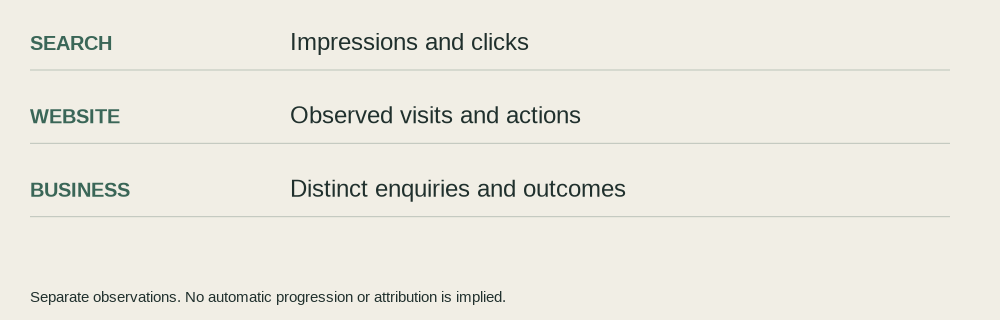
Search Console can describe search impressions and clicks within its reporting definitions. Website analytics can describe observed activity subject to configuration, consent and other gaps. The enquiry log records the conversations the business actually receives.
A discrepancy between these systems is not automatically a bug. They use different units, scopes, time zones and collection methods. A search click and a recorded session each describe a different event from a qualified enquiry. A blank referrer cannot establish direct discovery or AI discovery.
Google defines CTR as clicks divided by impressions in its Search performance report. Use that ratio for its intended scope. Do not divide an unrelated enquiry count by a different population of impressions and label the result a trustworthy conversion rate. First establish whether the records can be compared.
FIELDNOTE 05
Lower rate. More qualified enquiries.
Compare relevant volume alongside the percentage.
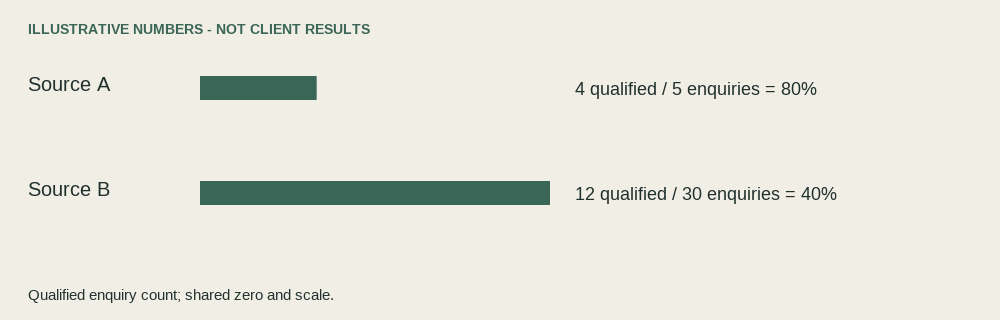
Illustrative enquiry figures: source A brings five enquiries, four qualified under the agreed rule: 80%. Source B brings 30 enquiries, 12 qualified: 40%. Source B has the lower qualification rate and three times as many qualified enquiries. Neither figure tells us the cost or eventual value of the work.
Before reacting, compare equivalent date ranges, relevant pages and the same metric definitions. Look for changes in the mix of services requested and the qualification criteria. A broad average can move because the audience changed, even if the offer stayed the same.
For a small business, a plain table of counts often beats a dramatic percentage arrow. Include the denominator and resist rounding away the small sample. A single additional enquiry could move the smaller sample’s rate sharply.
FIELDNOTE 06
Inspect the handover
A working button is only the beginning.
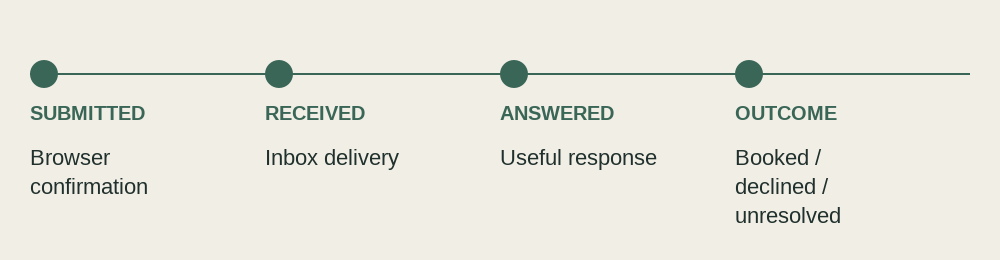
Test the journey a genuine prospect takes: read the offer, find the next step, submit the enquiry, receive confirmation and get a useful response. Use a clearly labelled test and avoid sending unnecessary personal information.
Distinguish what you observed. A successful browser message is not proof of inbox delivery. Inbox receipt is not proof that someone replied. A reply is not a booked call, and a booked call is not a sale. Record each event separately.
Check the fallback route too. A visible business email and clear expectation about the next step can help when a form fails. Do not promise response times the business cannot support. The measurement system should expose a missed handover rather than compensate with a nicer traffic chart.
FIELDNOTE 07
Change one useful thing
Give the experiment a question.
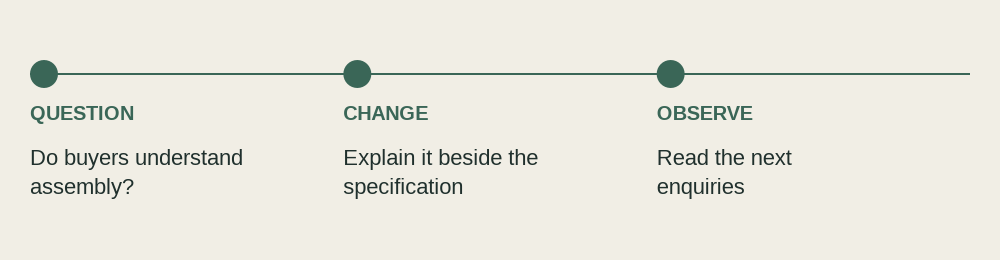
Suppose enquiries repeatedly ask whether assembly is included. A bounded change is to add a clear assembly explanation beside the desk specification and link the full terms. The hypothesis is that customers will arrive with fewer unresolved assembly questions.
Record the change, date, intended audience and what you will observe. Keep the enquiry question field consistent. Note other changes such as a promotion, service-area expansion or new campaign that could affect the comparison.
A before-and-after log can guide decisions, but it does not establish causation. With low enquiry volumes, qualitative notes may be more useful than a percentage. Read the actual questions and ask whether the new explanation resolved them.
FIELDNOTE 08
Read a small result honestly
Read the actual cases before drawing a conclusion.
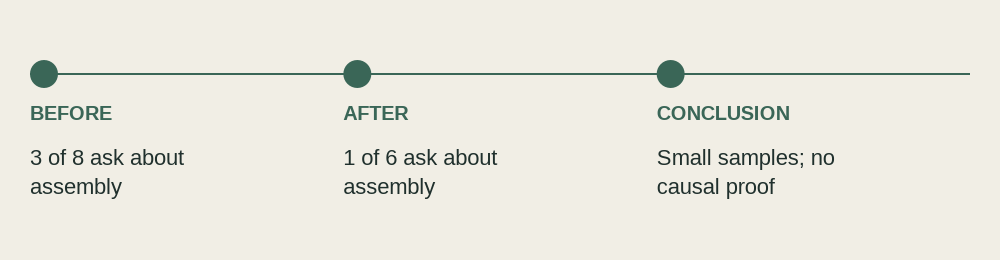
Invented example: before the page edit, 3 of 8 enquiries ask about assembly. After it, 1 of 6 does. It is tempting to call the change a large improvement. The counts are small, the people differ and other conditions may have changed.
A defensible note says: “Fewer assembly questions appeared in this small later sample. We will continue observing and inspect whether the page answers the question clearly.” It does not claim a proven conversion uplift or annual revenue gain.
Keep the page if it makes the service clearer and accurately reflects the offer. Evidence can support a sensible content decision without supporting a strong causal claim. You do not need a fake experiment result to justify answering a real customer question.
FIELDNOTE 09
The weekly ledger
A short review that ends with an action.
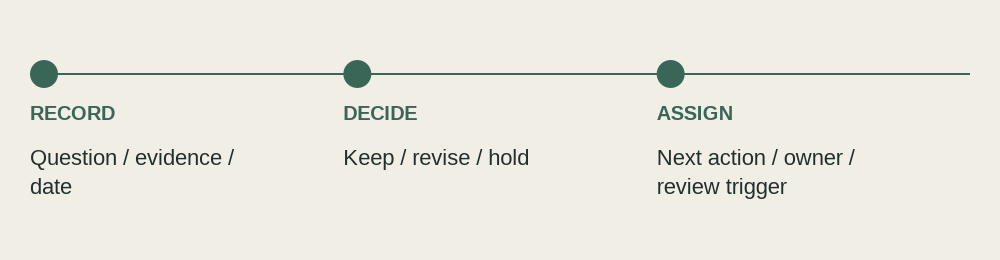
For each distinct enquiry, keep the date, internal reference, requested service, source as reported or observed, qualification status, next action, responsible person and outcome. Avoid putting unnecessary personal details in a shared reporting sheet.
Once a week, reconcile duplicates and read the unresolved cases. Which enquiries are waiting for a reply? Which question recurs? Which offer attracts people outside your scope? Which source is still unknown?
Use a short summary: counts by status, repeated questions, overdue actions and one proposed improvement. Keep booked work and revenue separate until they are confirmed in the business records. Track proposals sent and invoices paid as separate milestones.
| Enquiry reference | Source or unknown | Status | Next action and owner |
|---|---|---|---|
| Record here | Record here | Record here | Record here |
| Record here | Record here | Record here | Record here |
FIELDNOTE 10
A month with fewer guesses
Keep the loop small enough to maintain.
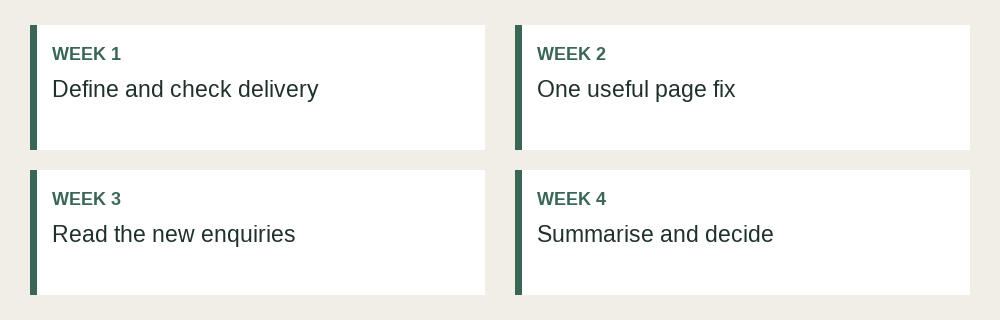
Week one: define the enquiry and check delivery. Week two: review recurring questions and choose one accurate page improvement. Week three: inspect the new conversations and any operational problems. Week four: summarise what you know, what remains unknown and what to try next.
This is a suggested rhythm, not a promised growth timetable. Some businesses receive too few enquiries for a useful monthly comparison; extend the period and retain the individual notes.
The workshop’s goal is a clearer buying conversation and fewer dropped handovers. Search visibility is one possible contributor. The business still needs a suitable offer, delivery capacity and follow-through.
Sources and editorial method
These reports combine original practical guidance with the specific primary references linked beside factual claims. They are not fresh tool benchmarks, customer case studies or guarantees. Examples are invented; historical research stays dated. AI-assisted drafting and critique supported production. References reflect the publication-date review; this is not a live or continuously checked report.
- Google: Search performance report - checked 19 November 2026.
Correction or question? hello@recallant.com
Explore all four issues