RECALLANT FIELDNOTES / ISSUE 01
The Evidence Desk
Check an AI answer before it reaches a customer.
Published 19 November 2026 · Editorial guide · Read with the publication-date context
A plausible answer needs a checkable source. This issue shows how to break a claim apart, inspect its support and decide what is safe to use.
Download the 12-page edition (PDF)This HTML edition is the accessible reading alternative to the visual PDF.
FIELDNOTE 01
The five-minute version
Start with the sentence that could cause trouble.
A small business does not need to investigate every adjective in a first draft. It does need to check statements that could change a customer’s decision: what is included, when something arrives, what it costs and whether it works with something they already own.
Our running example is an invented two-person furniture workshop. An assistant drafts a product reply promising delivery, assembly and a warranty. The owner knows the product well, which makes the fluent reply especially tempting to send. Familiarity is useful; it is also how a new promise slips past.
Read this issue with one draft open. Highlight its promises. For each, find the business record that supports it. If the record is missing, the answer is not ready. An AI reviewer can help find suspect sentences, but someone responsible for the business must settle the facts.
FIELDNOTE 02
One sentence. Three promises.
Grammar can hide several independent claims.
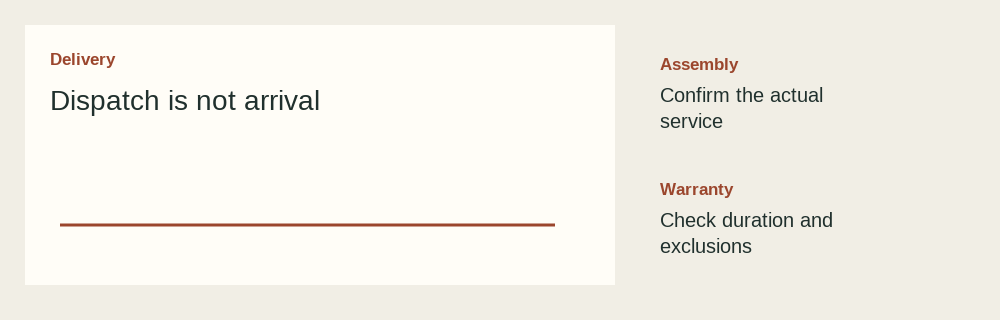
Invented draft: “Your desk arrives in three days, includes assembly and comes with a lifetime warranty.” That sentence has three claims. Each promise needs its own supporting record. A materials warranty, for example, may have a specific duration and exclusions.
Separate the clauses before checking. Copy each claim exactly into a small record, then add the source, its date and the relevant passage. Keep the original wording beside the proposed correction so a reviewer can see whether the meaning changed.
Do not turn an unanswered question into a negative fact. “We could not verify assembly” differs from “assembly is not available”. The first describes our evidence; the second describes the service. Only the business can confirm the second. Keep the assembly specification in one maintained record so colleagues do not reuse conflicting versions.
FIELDNOTE 03
Open the source
A link is a place to start reading.
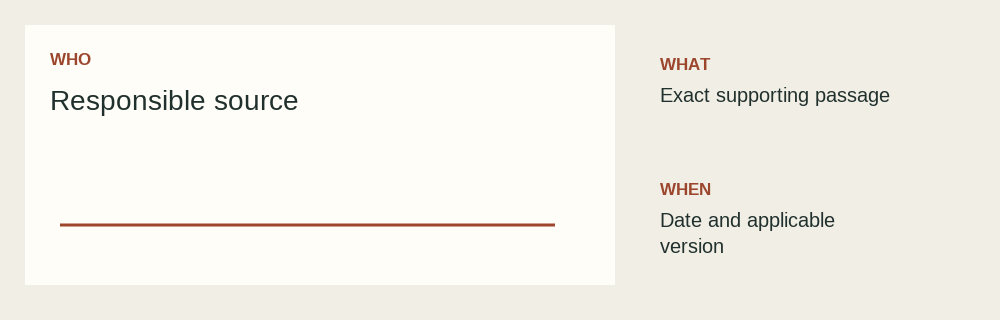
For the workshop, the strongest source for the assembly promise is its current service specification. A blog about buying furniture cannot establish what this workshop supplies. A manufacturer’s page may establish a component specification. The seller’s current specification and service terms describe its advertised offer; applicable statutory rights still apply.
Read beyond the search snippet. Check the page title, responsible organisation, publication or update date, applicable product and conditions. Find the passage that supports the exact claim, including exclusions. A source can be genuine and still be the wrong source for this question.
If a source cannot be opened, mark it unavailable. Keep the claim on hold when the consequence matters; do not allow the assistant to replace the missing evidence with a more confident paraphrase. A second AI repeating the answer is not an independent source.
FIELDNOTE 04
The claim ledger
A tiny table is more useful than a vague confidence score.
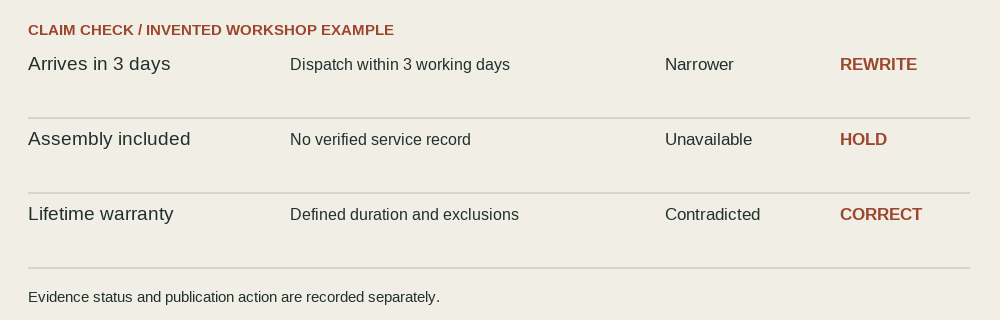
Illustrative workshop record: the workshop’s current service specification says “dispatch within three working days”; the draft says “arrives in three days”. Dispatch and arrival are different events. The corrected answer should use the actual dispatch commitment and explain how delivery is confirmed.
The assembly line has no supporting record. Mark it “unverified” and ask the owner. The warranty document specifies a duration and exclusions, so replace “lifetime” with the verified terms or link the current warranty without summarising beyond what has been checked.
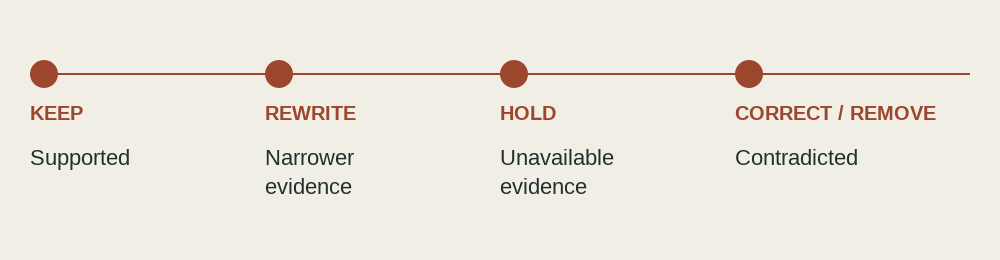
A good ledger records the decision as well as the problem. Otherwise the next editor repeats the investigation. Use four evidence states: supported, narrower than the draft, unavailable and contradicted. Map them to publication actions: keep, rewrite to the supported scope, hold, and remove or correct. If the source itself is wrong, its owner must correct it first.
FIELDNOTE 05
The date is part of the fact
A correct answer can expire.
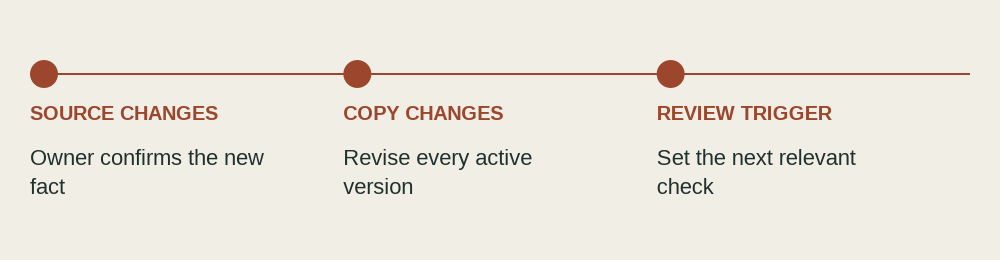
The workshop changes its assembly service for a new delivery area. Yesterday’s approved reply may now be wrong for some orders. An approval should therefore name the version of the source, the date checked and any condition that limits reuse.
Set review triggers around changes that matter: a new supplier, changed service area, price revision or revised warranty. A monthly reminder can help, but it does not replace a trigger when the underlying promise changes tomorrow.
For external rules, find the responsible authority and applicable jurisdiction. High-stakes legal, medical or financial questions require qualified review; this issue is an editorial workflow, not advice on those subjects. NIST’s voluntary risk framework is a useful reference for thinking about consequences and oversight. It is not a certification earned by using this worksheet.
FIELDNOTE 06
Rewrite without adding promises
Give the reader a specific fact and a clear next step.
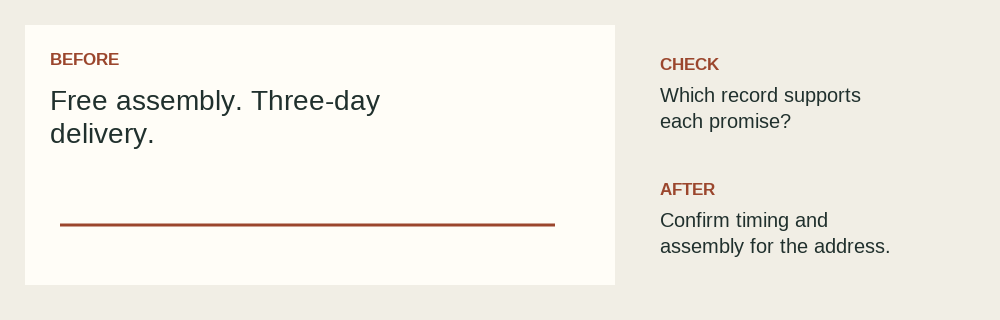
Invented original: “The perfect desk for every home office. Delivered in three days with free assembly.” A cautious rewrite is not simply “The excellent desk for your home office”. That leaves the practical questions unanswered.
A better illustrative reply: “This model is 120 cm wide. Our current specification lists dispatch within three working days. Ask us to confirm delivery timing and assembly for your address before ordering.” The measurements and dispatch statement would still need checking against the real product record.
Notice what the revision does: it gives one useful specification, preserves the difference between dispatch and delivery, and names the open question. It does not invent a guarantee to make the paragraph sound decisive. The reader now knows what is established and what to ask.
FIELDNOTE 07
Use a second reader well
Ask for disagreement, then resolve it.
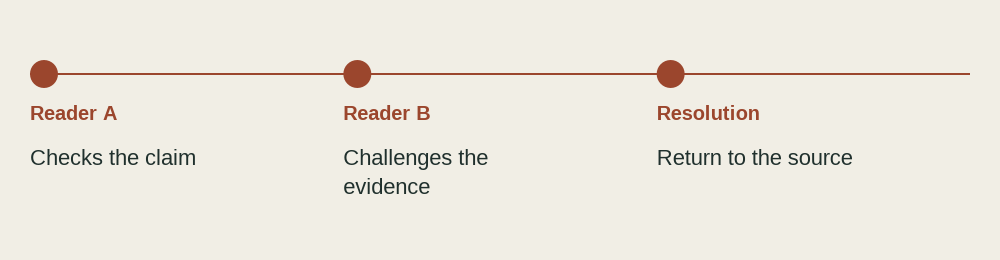
Give a reviewer the draft and the supporting records. Ask them to identify unsupported promises, altered numbers, missing conditions and statements whose source says something narrower. Request the exact sentence and the reason, not an overall score.
When two reviewers disagree, return to the source. A majority vote between models cannot change a warranty. If the document is ambiguous, the business owner decides what can actually be offered and updates the source.
Use non-sensitive examples when trying a new review tool. Check the service’s current data terms before uploading customer information. Inspect the reviewer’s output before accepting its recommendation. Record the disagreement and fix so the same weak sentence does not survive in the next brochure.
FIELDNOTE 08
A reusable check sheet
Complete this before a consequential claim leaves the desk.
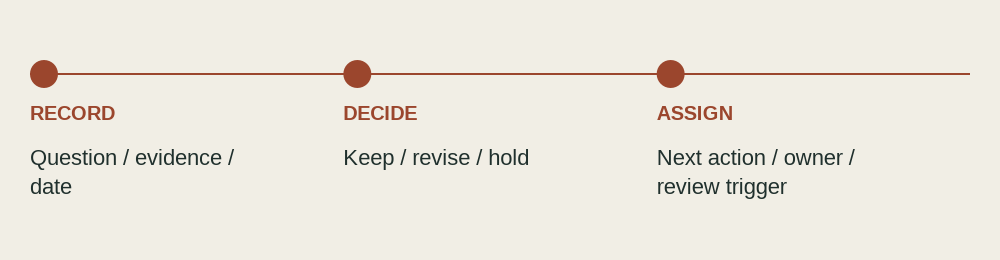
Record the asset and intended audience. List each material claim separately. For each claim, record the source URL or internal document version, the exact supporting passage, product or geographic scope, date checked and any exclusions.
Then record the decision: keep, rewrite, hold, or remove/correct. Save the final wording and the person responsible for approving the underlying business fact. If the source is unavailable, say so explicitly; an empty cell is too easy to mistake for a completed check.
Finally, compare the finished graphic or PDF with the approved text. Layout changes can drop a footnote, truncate a condition or leave an old price in a corner. The text file may be correct while the published image makes a different promise.
| Claim | Source and date | Evidence status | Action and owner |
|---|---|---|---|
| Record here | Record here | Record here | Record here |
| Record here | Record here | Record here | Record here |
FIELDNOTE 09
Know when to stop
The cost of checking should match the consequence.
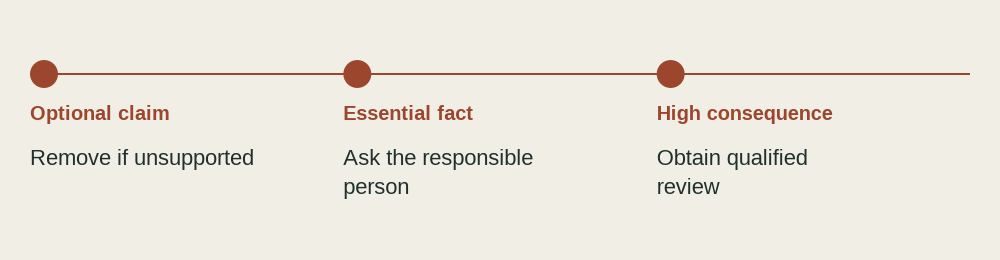
A harmless brainstorming list can carry unresolved ideas. A public product promise cannot. Separate exploratory drafts from material ready for customers, and make that status visible in the filename or work board.
If the evidence is unavailable and the claim is optional, remove it. If the claim is essential to the customer’s decision, ask the responsible person and hold the answer. Repeatedly asking different models until one supplies a pleasant answer is not verification; it is shopping for reassurance.
This method does not establish that every source is honest or complete. It reduces avoidable gaps between a statement and the records used to support it. For decisions with serious consequences, qualified domain review remains necessary even when the citations look tidy.
FIELDNOTE 10
Put it to work this week
Choose one frequently reused answer.
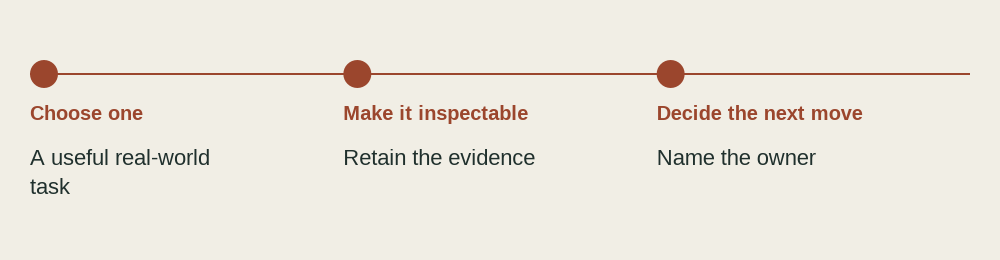
Take a product reply, proposal paragraph or website FAQ that customers actually read. Check its material promises using the worksheet. Correct the source record first if the business itself has changed; then update the copy and every active version that reuses it.
Keep one short change note: what was wrong, what supports the correction and where the corrected text now appears. This is enough to make the next review easier without creating a paperwork business inside your business.
For the invented workshop, the useful outcome is modest: customers receive an accurate dispatch statement and a clear way to confirm assembly. We have not measured conversion, prevented a real complaint or tested this example on an AI system. The example teaches a checking method; it is not a customer result.
Sources and editorial method
These reports combine original practical guidance with the specific primary references linked beside factual claims. They are not fresh tool benchmarks, customer case studies or guarantees. Examples are invented; historical research stays dated. AI-assisted drafting and critique supported production. References reflect the publication-date review; this is not a live or continuously checked report.
- NIST: AI Risk Management Framework - checked 19 November 2026.
Correction or question? hello@recallant.com
Explore all four issues